
Manual of product Tucson (2009)
Editorial note
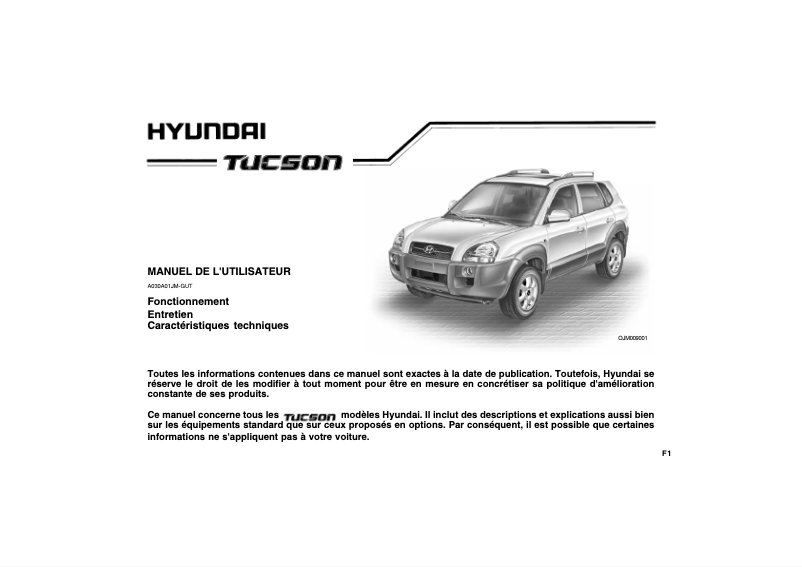
The Hyundai Tucson (2009) stands out for its reliability and durability, providing peace of mind to drivers. Its spacious and comfortable interior makes it an ideal option for families, especially on long trips. Additionally, it is designed to optimize fuel consumption, which helps reduce operating costs. Ease of use is a major asset, supported by a clear and accessible user manual. However, this model also has some drawbacks. Its fuel consumption is relatively high compared to newer models, which can increase operating costs. Furthermore, the technology and interior features are somewhat dated, particularly in terms of connectivity and infotainment, which may not meet the expectations of modern users. Finally, some owners have reported reliability issues, particularly concerning electronic components. In summary, the Hyundai Tucson (2009) offers good value for money due to its robustness and interior space. However, improvements could be made in terms of driving performance and technology to better compete with contemporary models.Score details
User experience
The user experience is generally positive thanks to a spacious and comfortable cabin, but the technology and interior features are a bit dated.
Performance
The driving performance is average, with handling that may feel less agile compared to newer SUVs.
Design
The design is functional and family-oriented, but lacks originality compared to newer models.
Value for money
The value for money is good, especially considering its reliability and durability.
Usability
Ease of use is enhanced by a clear user manual, making the car accessible even for less experienced users.
Support
Support is acceptable, although some owners have reported reliability issues.
Features
The features are practical but limited, especially in terms of connectivity and infotainment.
Robustness
Robustness is a strong point, with the Hyundai Tucson (2009) being known for its durability and long-term reliability.
Documentation
The user manual is comprehensive and helps in understanding the various features of the car.
Advantages
Recognized reliability and durability
Spacious and comfortable cabin
Optimized fuel consumption
Simple and accessible technology
Advanced safety features
Disadvantages
High fuel consumption
Outdated interior technology
Average driving performance
Limited cargo space
Reported reliability issues
Technical Specifications Tucson (2009)
General Information
-
ModelTUCSON (2009)
-
Brand
-
Category
-
Type
-
SKU777271
-
MPN777271
Frequently Asked Questions
How to convert miles to kilometers?
Where can I locate the VIN number of my Hyundai?
What is the VIN number?
What is the recommended frequency for servicing my Hyundai?
How often should I change the brake fluid in my Hyundai?
What are the differences between E10 and E5 gasoline?
What should I do if one or more doors do not open from the inside?
My car radio won't turn on, what should I do?
Why won't my car start when I turn the key?
Why isn't the air conditioning cooling my car?
What should I do if my car overheats?
Why are my brakes making a squeaking noise?
How to reset the Tire Pressure Monitoring System (TPMS) light on the 2009 Hyundai Tucson?
Is the manual for the 2009 Hyundai Tucson available in French?
Similar products


More product categories from brand Hyundai
Audio Hyundai
Household appliances Hyundai
Garden and outdoor Hyundai
Home appliances Hyundai
Tools Hyundai
Other Hyundai
Phones Hyundai
Interior Hyundai
More product types from brand Hyundai


Presentation of product Tucson (2009) specifications from brand Hyundai
General Information
The Hyundai Tucson (2009) is an SUV that is part of the vehicle range of the Hyundai brand, known for its reliability and innovation. This Tucson model, launched in 2009, stands out for its solid performance and appreciable comfort for passengers. Designed to meet the needs of families and active drivers, it offers a pleasant and safe driving experience.
Advantages
Reliability: The Hyundai Tucson (2009) is widely recognized for its durability, providing a reassuring peace of mind for drivers during their journeys.
Interior space: This vehicle offers a spacious cabin, perfect for long family trips, thus providing optimal comfort for all passengers.
Fuel consumption: Although designed to optimize consumption, it is worth noting that the model may show slightly higher consumption than some recent competitors, impacting operating costs.
Accessible technology: Equipped with practical features and a clear user manual, the Tucson (2009) is easily understandable and user-friendly.
Safety: This model is equipped with several safety features, ensuring adequate protection for all its occupants.
Disadvantages
Outdated technology: Some interior and connectivity features may seem obsolete compared to more recent models, which may not satisfy modern users.
Driving performance: The handling may appear less agile compared to that of newer SUVs, thus affecting the driving experience.
Limited cargo space: The cargo space may be insufficient for some users, especially those with greater transport needs.
Reliability issues: Some owners have reported concerns, particularly regarding electronic components, which may affect confidence in the vehicle.


