

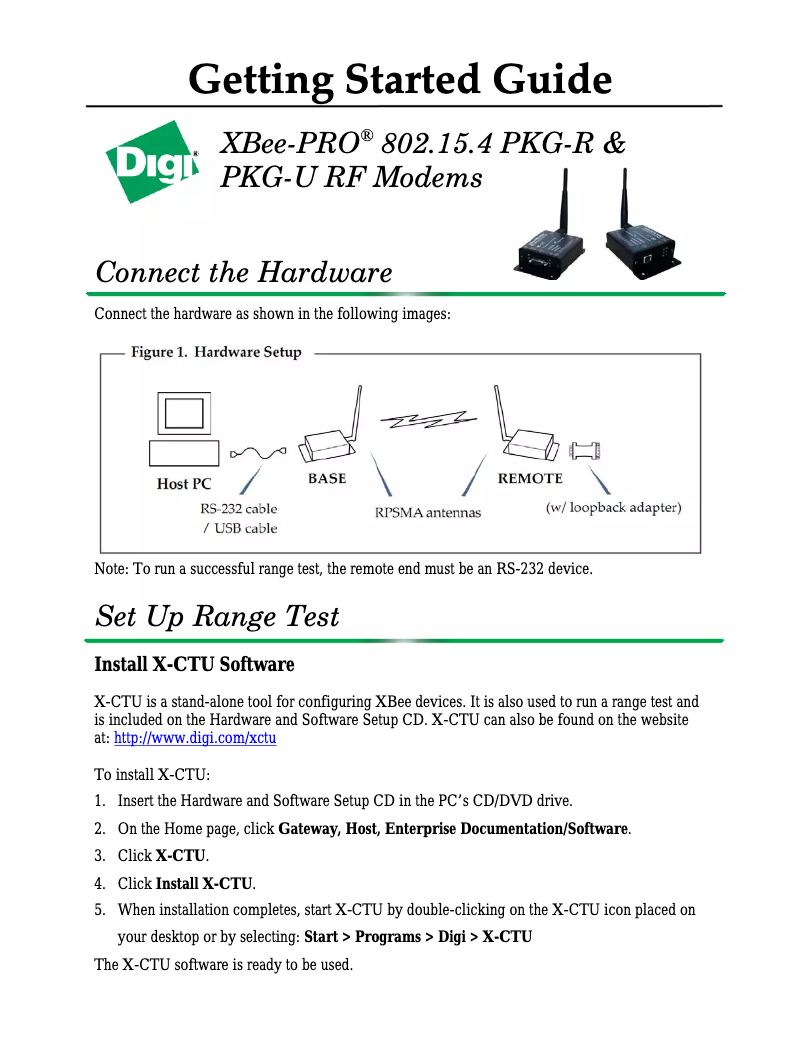
Manual of product XBee-PRO PKG
Editorial note
The Digi XBee-PRO PKG is a product that stands out for its efficient connectivity thanks to the IEEE 802.15.4 topology, offering fast and stable data transmission. Its low power consumption of only 6 mA is a major asset, allowing for prolonged use without overconsumption. Additionally, its wide operating temperature range of -40 to 85 °C ensures reliable performance in various environments, making it a robust choice. However, some drawbacks are worth mentioning. The transmission range may be limited in very crowded environments, which can affect network performance. Furthermore, the data rate of 9.6 Kbit/s may not be sufficient for applications requiring faster transfer. The RS-232 interface, while simple, may seem less convenient for modern users who prefer USB or wireless connections. Finally, with a weight of 150 g, the product may appear a bit heavy for portable devices. In terms of user experience, although the RS-232 interface enhances connectivity, it may not meet the expectations of all users. Performance is generally satisfactory, but the data rate could be a hindrance for certain applications. Nevertheless, the Digi XBee-PRO PKG offers good value for money, supported by FCC, IC, and EC certifications that ensure its compliance with safety standards. In summary, the Digi XBee-PRO PKG is a high-performing and robust device, ideal for use in various environments, but it is important to consider its limitations in terms of range and data rate for specific applications.Score details
User experience
The user experience is improved thanks to an RS-232 interface, but this connection may be less convenient for some modern users.
Performance
The performance is satisfactory for effective connectivity, but the data rate of 9.6 Kbit/s may limit its use for more demanding applications.
Battery life
The low power consumption of 6 mA allows for prolonged use, which is a considerable asset for battery life.
Design
The weight of 150 g may seem high for portable applications, but the dimensions are well thought out for an optimal fit.
Robustness
The wide operating temperature range of -40 to 85 °C ensures reliable performance in various environments.
Value for money
Certified by FCC, IC, and EC, the product ensures compliance with safety standards, which justifies a good value for money.
Usability
Although the connectivity is effective, the transmission range may be limited in cluttered environments.
Advantages
Fast transmission with IEEE 802.15.4 topology
Low power consumption: 6 mA
Temperature range: -40 to 85 °C
Simple connection via RS-232 interface
FCC, IC, and EC certifications included
Disadvantages
Limited range in cluttered environments.
9.6 Kbit/s throughput insufficient.
Inconvenient RS-232 interface.
High weight of 150 g.
Voltage range requires specific adapters.
Technical Specifications XBee-PRO PKG
General Information
-
ModelXBEE-PRO PKG
-
Brand
-
Category
-
Type
-
SKU1032742
-
MPN1032742
Technical details
-
InterfaceRS-232
-
Network topologyIEEE 802.15.4
-
Current received80 mA
-
Current transmitted300 mA
-
Low current power6 mA
-
Data rate range9.6 Kbit/s
-
Operating frequency2400 MHz
-
Receiver sensitivity-100 dBm
-
ModulationOQPSK
-
Method of spectrum propagationDSSS
Antenna
-
Antenna connector typeRP-SMA
-
Impedance50 Ohm
Power
-
Input voltage5 - 14 V
Weight and dimensions
-
Dimensions (LxWxH)114 x 70 x 29 mm
-
Weight150 g
Indication
-
Connectivity LEDsYes
Environmental conditions
-
Operating temperature-40 - 85 °C
Certificate
-
CertificationFCC
-
IC
-
EC
Network
-
Support for network topologiesPeer-to-peer
-
Point-to-multipoint
-
Point-to-point
Frequently Asked Questions
What is the weight of the Digi XBee-PRO PKG?
What certifications does the Digi XBee-PRO PKG have?
Is the manual for the Digi XBee-PRO PKG available in French?
Similar products


More product categories from brand Digi
Other Digi
Software Digi
More product types from brand Digi




Presentation of product XBee-PRO PKG specifications from brand Digi
General Information
The Digi XBee-PRO PKG is a product from the Digi brand, known for its excellence and innovation in the communication technology sector. This specific model, designated as XBee-PRO PKG | XBP24-PKI-001-R, is designed to deliver optimal performance, thereby enhancing the user experience.
Technical Details
This device is equipped with a RS-232 interface, facilitating a quick and easy connection with various devices. Its network topology is based on the IEEE 802.15.4 standard, ensuring efficient and fast connectivity. The Digi XBee-PRO PKG operates with a receive current of 80 mA and a transmit current of 300 mA, while standing out for its low power consumption of only 6 mA.
Its data rate range reaches 9.6 Kbit/s, suitable for many connectivity applications. It operates at a frequency of 2400 MHz and has a receiver sensitivity of -100 dBm, ensuring a stable connection even in challenging environments. The modulation used is of type OQPSK, while the spreading method is based on DSSS, optimizing data transmission.
Antenna
The Digi XBee-PRO PKG is equipped with an RP-SMA antenna connector, essential for ensuring optimal signal reception. Its impedance is 50 Ohm, which helps maintain high communication quality.
Power
This module operates with an input voltage ranging from 5 to 14 V, ensuring compatibility with most standard electrical systems.
Weight and Dimensions
The dimensions of the Digi XBee-PRO PKG are 114 x 70 x 29 mm, allowing for easy integration into various environments. With a weight of 150 g, it remains lightweight and manageable for practical use.
Indication
This product is equipped with connectivity LEDs that provide visual indications, thus facilitating user interaction.
Environmental Conditions
The Digi XBee-PRO PKG is designed to operate within an extended temperature range, from -40 to 85 °C, ensuring reliable performance in varied environments.
Certification
This model is certified compliant with FCC, IC, and EC standards, thus ensuring the safety and performance of the product.
Network
The Digi XBee-PRO PKG supports multiple network topologies, such as Peer-to-peer, Point-to-multipoint, and Point-to-point. This diversity offers flexible usage tailored to many connectivity needs.


